

In automated polishing operations, the air pressure setting of the liquid polishing wax spray gun directly affects the atomization effect and adhesion uniformity of the polishing agent, thereby determining the final polishing quality of the workpiece. When paired with consumables such as liquid polishing wax, polishing compounds, polishing paste, as well as tools such as airway buffing wheels, polishing buffing wheels, cotton buffing wheels, sisal wheel, and wire drawing wheels, precise control of air pressure is the core prerequisite for achieving efficient polishing.
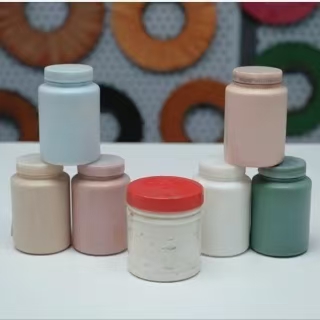
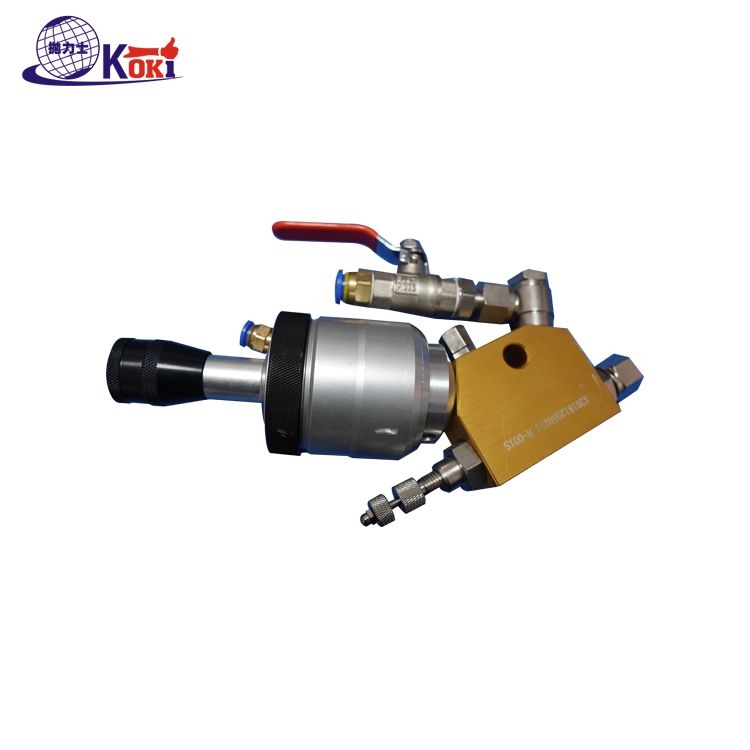
The air pressure of the liquid polishing wax spray gun is not a fixed value and needs to be flexibly adjusted according to the polishing stage, consumable type, and workpiece material. Generally speaking, the working pressure range of the spray gun is between 0.2-0.6MPa, and there is a clear adaptation logic for the pressure selection in different scenarios.
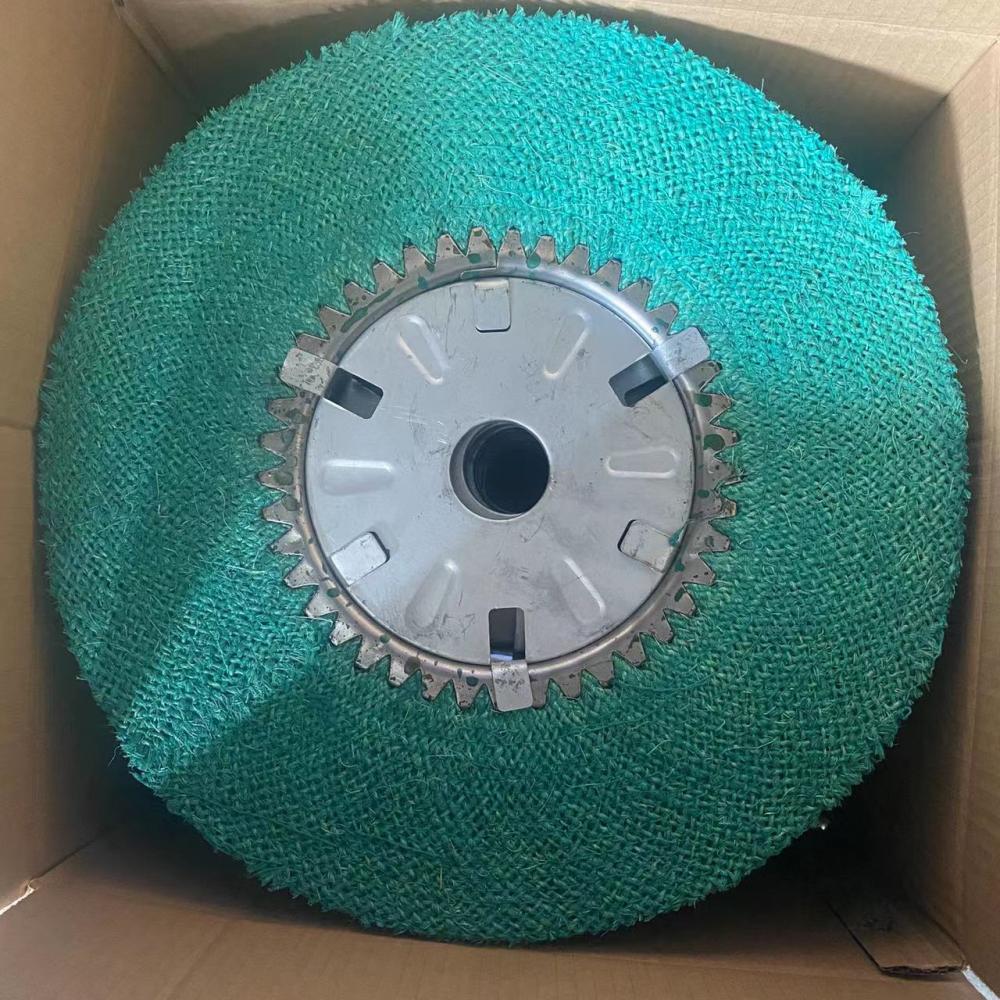
In the rough polishing stage, it is common to use sisal wheels combined with coarse-grained polishing compounds. At this time, the air pressure of the spray gun needs to be adjusted to 0.4-0.6MPa. Higher air pressure can make the liquid polishing wax spray evenly on the surface of the sisal wheel in a mist form. With the strong cutting force of the sisal wheel, burrs, scratches, and machining allowances on the surface of the workpiece can be quickly removed. If the air pressure is too low, the atomization effect of liquid polishing wax is poor, and local accumulation is prone to occur, which not only causes waste of consumables, but also leads to uneven polishing patterns; If the air pressure is too high, it will cause the polishing agent to rebound and splash, reducing the actual utilization rate.
In the precision polishing process, polishing cloth wheels and cotton cloth wheels are often used in combination with delicate liquid polishing wax or polishing paste. At this time, the air pressure needs to be lowered to 0.2-0.4 MPa. Mild air pressure allows the polishing agent to cover the soft surface of the cloth wheel lightly and evenly. With the low-speed operation of the robotic arm, the surface smoothness of the workpiece is gradually improved, avoiding the penetration of the polishing agent too deep due to high air pressure, which may cause fine scratches on the workpiece surface. For workpieces that require a wire drawing effect, it is recommended to control the air pressure at 0.3-0.5MPa when working with a wire drawing wheel. This can ensure that the liquid polishing wax fully lubricates the wire drawing wheel and accurately control the consistency of the depth of the wire drawing pattern.
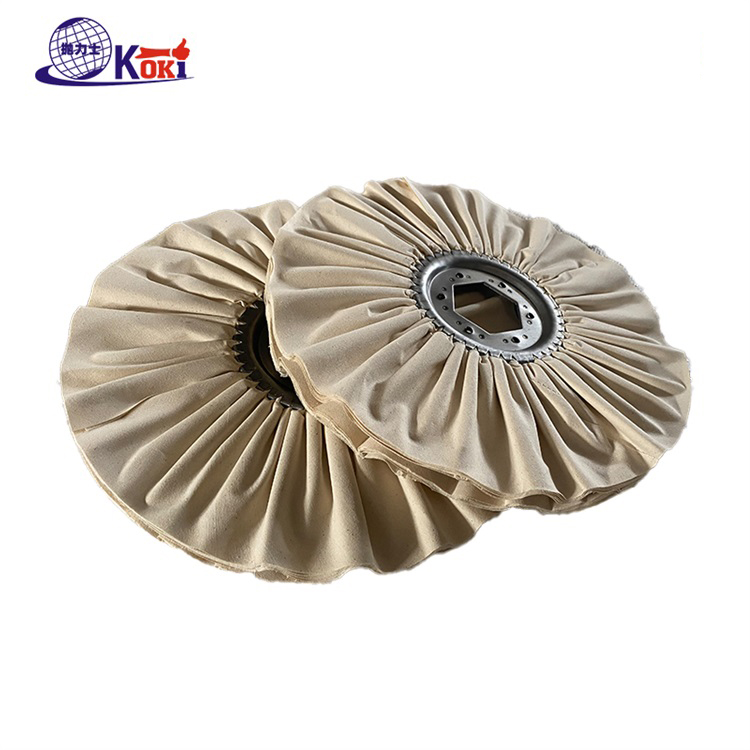
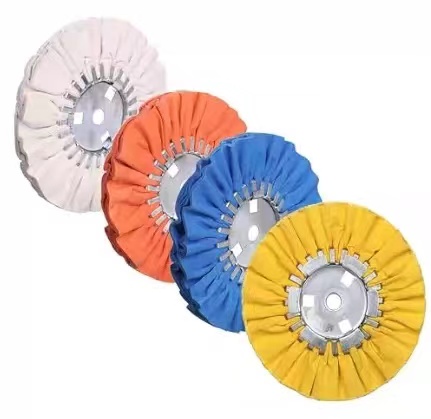
The airway polishing wheel, due to its built-in breathable and heat dissipation structure, requires flexible adjustment of the spray gun pressure according to the polishing material. When polishing hard materials such as stainless steel, the air pressure can be set to 0.45-0.6MPa, and polishing compounds can be used to enhance the grinding force; When polishing soft materials such as aluminum alloys, the air pressure should be reduced to 0.25-0.4 MPa, and liquid polishing wax should be used to avoid deformation or scratches on the surface of the workpiece.
In addition, regardless of the polishing scenario, attention should be paid to the distance between the spray gun and the polishing wheel, usually kept at 10-15 cm, combined with reasonable air pressure parameters, in order to maximize the effectiveness of liquid polishing wax and other consumables. At the same time, regularly cleaning the spray gun nozzle to prevent residual blockage of polishing paste or polishing compound is also an important operation to maintain stable air pressure and ensure polishing effect.
In summary, the air pressure regulation of liquid polishing wax spray guns should follow the principle of "rough polishing high pressure, fine polishing low pressure, and material pressure regulation", combined with the characteristics of different polishing wheels and types of polishing agents, in order to achieve a dual improvement in polishing efficiency and quality.
